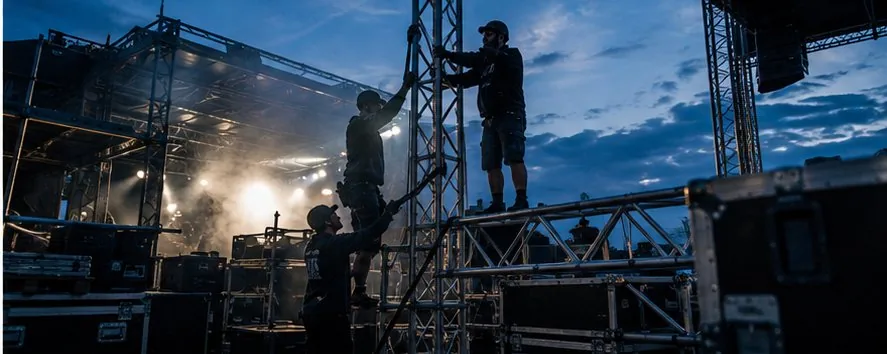
The UK is very good at live events. Its agencies, fabricators and production crews create brand activations that take over whole warehouses, exhibition stands finished to showroom standard and festival stages people talk about for years. It is creative, technical work and the world pays attention to it.
Then the show closes. Within hours, a large share of that work is broken down, loaded into skips and sent off to be recycled, incinerated or buried. The next campaign starts from scratch.
An industry that keeps growing
The commercial case for events has rarely been stronger. The UK Events Report 2025 from UKEVENTS valued the industry at an estimated £68.7 billion, with growth forecast at 3 to 5% a year through 2027, ahead of many EU markets.1 The Events Industry Alliance counted around 1,154 exhibitions and conferences at the UK's main exhibition venues in 2025, drawing an estimated 6.8 million visits. That was the highest number of shows since 2015, and exhibitions alone generated £11.5 billion in economic output while supporting 126,000 jobs.2
“Events are a proven growth engine for the UK economy.”
Glenn Bowdin, Chair, UKEVENTS3
Why real life matters more in an AI world
Part of that momentum comes from somewhere you might not expect. As AI floods inboxes, feeds and search results with content, people are placing more value on the things they can see and touch for themselves.
EventTrack 2026, Event Marketer's annual study of more than 1,000 US corporate marketers and attendees, found brands across all sectors expect to spend 8 to 11% more on events this year. Sixty-one per cent of attendees said they were more inclined to buy after a live experience and 59% came away feeling more positive about the brand. The report's authors put it plainly: audiences are realising “the only reality they can trust is the one they experience themselves.”4
Freeman's Belief Gap research points the same way. In that study, 97% of marketers said events and event content matter for whether their brand shows up in AI-generated answers, and 45% blamed a lack of in-person touchpoints for the gap between people knowing a brand and genuinely believing in it.5 UK budgets are following. In the IPA Bellwether Report, events were the fastest-growing area of UK marketing spend in the first quarter of 2026, with a net balance of +14.7% of companies increasing budgets, and they led again in the second quarter at +11%.6,7 Commenting on the figures, Fiverr's chief marketing officer Matti Yahav said people are “looking for something real”.7
For the most innovative brands, the physical experience has become the part of the marketing mix that can't be faked. That is good news for the industry. It is less good news for the planet.
Build it, use it, bin it
Sustainability body isla published its A Closer Look: Materials report in July 2026, drawing on data from 789 events. It estimated that 1,229 tonnes of event materials were used once and then thrown away. Across the dataset, 42% of build materials were only ever used once, 84% of all materials were virgin and 78% of event carpet went into the waste stream after a single event. The disposal bill alone came to almost £500,000, or more than £600 per event.8
What stands out is “the volume of waste that's become normalised and accepted as part of doing business.”
Emily Shephard, Insights Lead, isla8
Exhibition stands are a big part of the picture. Informa, one of the world's largest exhibition organisers, says a single medium-sized disposable stand produces around four tonnes of waste, almost ten times the average person's annual household waste. In 2019, disposable stands made up more than 80% of all the waste generated at Informa's events.9,10
Venues have done a lot to deal with what's left behind. ExCeL London has run a zero-waste-to-landfill policy since 2012, and the NEC Group says it recycles 82% of its waste.11,12 But keeping a one-off build out of landfill is a long way from keeping it in use. What can't be recycled is burned for fuel, and even the material that is recycled loses all the design, craft and budget that went into it. When RX and ExCeL tackled waste at WTM London 2024, stand builds were identified as the biggest problem.13
None of this is new. A 2023 study commissioned by Vision: 2025 and Julie's Bicycle estimated that UK festivals produce around 25,800 tonnes of waste a year.14 What has changed is the cost of carrying on. Landfill Tax rose to £130.75 a tonne in April 2026, and audiences are paying attention: 73% of attendees surveyed for EventTrack 2026 said they care about how sustainable an event is.15,4 The same study found that when budgets get tight, sustainable options are usually the first thing to go.
The storage trap
Plenty of brands and agencies would rather keep their builds. A bespoke set, a modular stand or a run of high-quality props can represent thousands of pounds of design and craftsmanship. The problem is where to put them.
Self-storage is the obvious answer, and it is not cheap. Market-leading commercial self-storage operators in major cities are charging an average of around £36 per sq ft a year, rising to more than £38 at their established stores.16 The Self Storage Association UK's 2025 industry report put the London average at nearly £45 per sq ft a year, more than double the cost in the West Midlands and Wales. Consumer group Which? found that a 150 sq ft unit in London typically costs £400 to £600 or more a month.17
Scale that up to event stock and the numbers climb quickly. At the London average, a 300 sq ft unit holding one brand's stand, set pieces and props comes to around £13,500 a year before VAT. For a build that may or may not be used again, that is a hard number to defend in a budget meeting.
And storage on its own rarely fixes anything. No two campaigns are the same, so items sit in a unit nobody visits, nobody quite remembers what's in there and eventually the lot gets skipped anyway. The money spent storing it simply delays the bin.
Breaking the cycle
This is the gap Circular Storage was set up to close. The company was founded by two events veterans with more than 60 years of combined experience producing events and festivals for promoters, brands and agencies. They describe the cycle they kept seeing as: build it, use it, store it, forget it, build it again. The service is designed to break each stage of that loop.
Store it somewhere sensible. Circular Storage's secure, air-controlled warehousing sits outside London, which brings costs down significantly compared with city storage without making assets harder to reach.
Know what you own. Every item is photographed, catalogued and archived, giving clients a visual inventory they can check online at any time. When the next brief lands, the team can see what they already have before anyone orders a single sheet of MDF.
Get it where it needs to be. Transport, rigging and de-rigging are handled across the UK and mainland Europe, either on a plan built around a client's events calendar or on demand, with items ready and delivered within days.
Make it new again. This is the part that tackles the “no two campaigns are the same” problem head on. Circular Storage's in-house fabrication team adapts, repairs and rebuilds existing assets between seasons, so last year's activation becomes the starting point for this year's instead of landfill.
For companies with stock already scattered across other units, moving is made easier too. Circular Storage can deduct up to 100% of relocation costs from the first 12 months' storage fee, subject to survey and a 12-month agreement.
The best build is the one you don't have to make
The growth of the UK events industry is something to be proud of, and its ambition doesn't need to shrink. What needs to change is the habit of treating extraordinary work as disposable. Informa's own guidance notes that reusable stands generally cost less than disposable ones, and the isla data shows the decisions that cut carbon tend to cut cost as well.10,8
As Circular Storage puts it, the most sustainable build is the one you don't have to make.
Keep your next build in use
Secure, catalogued storage outside London, UK and European logistics, and in-house fabrication that gives your assets another season. Get a price in a couple of minutes.
Sources
- UKEVENTS, UK Events Report 2025 (via NCASS)
- Events Industry Alliance, SASIE 2025 (via Kongres Magazine)
- UKEVENTS Autumn Budget submission, November 2025
- Event Marketer, EventTrack 2026 executive summary
- The Freeman Company, The Belief Gap (via Trade Show Executive)
- IPA Bellwether Report Q1 2026
- The Drum, IPA Bellwether Q2 2026
- isla, A Closer Look: Materials (via AMI Magazine), July 2026
- Informa, Better Stands exhibitor information guide
- Informa, Better Stands at Vitafoods Europe
- ExCeL London, Reducing waste
- NEC Group, Greener arenas
- RX, Working together towards Net Zero Carbon Events
- Julie's Bicycle and Vision: 2025, Towards Zero Waste Festivals, 2023
- HMRC, Landfill Tax rates from 1 April 2026
- Annual report data from a market-leading UK self-storage operator, year to March 2026
- Which?, Self-storage: how much it costs, citing SSA UK Annual Industry Report 2025